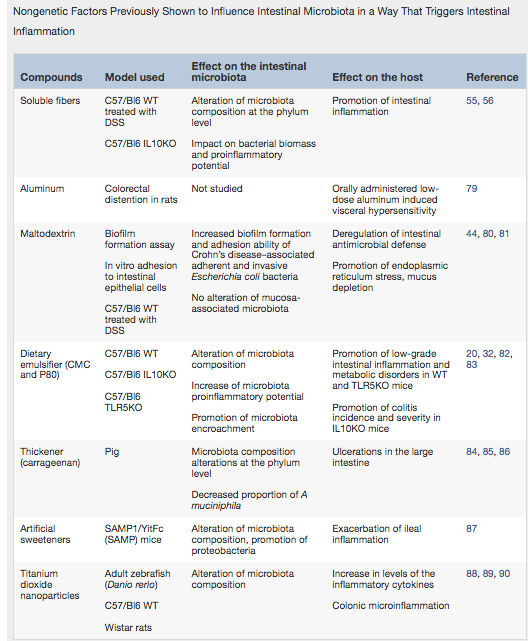
“Nongenetic Factors… Shown to Influence Intestinal Microbiota in a way that Triggers Intestinal Inflammation”

Dear Readers,

Notice that Caraageenan, previously addressed on this blog, is featured on the list. I personally avoid foods (and toothpaste!) that contain it. In case I didn’t mention it earlier, it can also be found in some beers. Anyway, please check out this article and the chart inside:

https://www.cmghjournal.org/article/S2352-345X(19)30024-4/fulltext

and the PDF if you wish to download it:

https://www.cmghjournal.org/article/S2352-345X(19)30024-4/pdf

Hydrogen Sulfide vs. Butyrate

If you have IBD, this is something you should know about. I try to avoid high sulfur foods (list forthcoming) in favor of low-sulfur ones.

A common theme of this blog (and my health efforts) that I urge you to consider for yourself (in whatever way makes sense for you) is to eat things that support the gut lining and a healthy microbiome, and that reduce inflammation. And avoid foods/ingredients that degrade the microbiome, increase intestinal permeability (and/or damage the intestines), and cause inflammation.

My hope is that this blog will serve as a resource that helps you discern what these foods/ingredients are (backed by science and evidence).

A randomized trial of the effects of the no-carrageenan diet on ulcerative colitis disease activity

As I said in an earlier post, I avoid foods containing carrageenan and I think you should too.

CONCLUSION: Carrageenan intake contributed to earlier relapse in patients with ulcerative colitis in remission. Restriction of dietary carrageenan may benefit patients with ulcerative colitis.

https://www.ncbi.nlm.nih.gov/pmc/articles/PMC5389019/

Foods that Commonly Include Carrageenan

Get in the habit of reading labels if you don’t already. If a product contains Carrageenan I DON’T eat it

  • almond milk

  • bakery products with glazes, frostings

  • beer

  • candy

  • canned fish, meats

  • chocolate milk mixes/powders

  • condensed milk

  • evaporated milk powders

  • cottage cheese

  • dietetic beverages

  • deli meat

  • frostings

  • gelled fruit snacks

  • ice cream, frozen custard and other frozen desserts

  • infant formulas

  • liquid coffee whitener

  • maple syrups

  • meal replacements

  • nutritional drinks

  • pie filling

  • processed meats, fish or cheese

  • pudding

  • ricotta cheese

  • soy milks

  • whipped cream

  • yogurt 

Food Ingredient to AVOID: Carrageenan

“UIC physician and professor Joanne Tobacman, has been looking at the health effects of carrageenan for more than a decade and is concerned enough to have petitioned the U.S. Food and Drug Administration in 2008 to prohibit the use of carrageenan in food. Her petition cited decades of publicly funded, peer-reviewed science — including her own — on carrageenan-induced inflammation in animals and cells. In June, the FDA responded with a letter of denial.Tobacman said “it was disappointing that, with such clear evidence about the effects of carrageenan on inflammation, the FDA did not restrict the use of carrageenan, particularly in infant formula.” Europe doesn’t allow the ingredient in formula….

…In 2001, Tobacman published a scientific review in a National Institute of Health journal suggesting that consumption of carrageenan in lab animals was associated with “intestinal ulcerations” and tumors. She concluded that the “widespread use of carrageenan in the Western diet should be reconsidered. Beyond the acute reaction it triggers in some, Tobacman said in a recent email, carrageenan may also promote low levels of chronic internal inflammation, a factor linked to common chronic disorders such as diabetes, atherosclerosis and arthritis…

The additive, which lends a uniform, creamy texture to food, can be found in soy milk, yogurt, ice cream, cheeses, some meats, diet soft drinks and even toothpaste.”

https://www.chicagotribune.com/lifestyles/ct-xpm-2013-03-18-ct-met-carrageenan-0318-20130318-story.html
Design a site like this with WordPress.com
Get started