Should You Eat a Plant Based Diet with UC?

Back when I was diagnosed a couple of decades ago, I asked my gastro. at the time if I should keep drinking coffee. He was dismissive and said diet has nothing to do with it. I’m not 100% sure if this was the medical establishment view back then but I think it was, I think only in the last few years has this begun to change (with burgeoning research and focus on the microbiome). Back then, it seems UC / IBD was viewed mostly as an autoimmune issue of “unknown etiology” and without a cure. I was a young adult when I was diagnosed and at the time, the regimen was Mesalamine and Immunomodulators like 6MP were coming into play, besides rectal meds and the dreaded course of steroids, namely Prednisone. Biologics weren’t around then.

Since these meds, while helpful, left a lot to be desired for me (before taking 6MP, I recall always having an emergency dose of Immodium in my pocket), I began searching for info., what little there was back then, on the nascent internet. That early research ended up being ongoing (culminating in this blog). Anyway, as far as a plant based diet, I recall coming across the site of this guy who claimed to be a former stressed out stock broker who abandoned that lifestyle in favor of moving to Florida and adopting a raw plant based diet, which he said helped. As I said, I was a young adult, preparing to embark on my career, ambitious and excited about my prospective path, so the idea of pulling the plug, taking an extended vacation if not dropping off the grid entirely, and adopting a raw vegan diet didn’t seem appealing or feasible. And frankly, while I sympathize, at the time, the guy seemed like a bit of an eccentric.

Someone else I came across, or rather his book – David Klein – Self Healing – Colitis and Crohns. I didn’t read it back then as it also seemed extreme to me, and also kind of “quacky” or “snake oily”. I was, and still am, wary of anyone who tells you there’s a way you can cure your incurable, chronic illness and surprise…charges $ for it. I’ve since looked over Klein’s book and while it seems repetitive and overly complex to me (perhaps it’s the presentation) in terms of what you can eat and when over an extended period of time, the gist it of it, which is sensible, is you eat certain foods while in a flare to heal (say, papaya), and then once you can tolerate other food items, progress to sweet potatoes and so on. I’m paraphrasing… He has adherents, who seemed to have used his system successfully, going into remission.

Fast forward to now, or the last few years, and there has been lots of evidence-based, as it’s called, research into plant based diets in treating disease. It’s known that a strict plant based diet can reverse heart disease. And just last week I read about this patient who was healed through a plant based diet.

Around the same time, this report appeared about a low cal. fast-mimicking diet that had good results with mice. Notably, this reminded of a recent book by Dr. Michael Mosely, The Clever Gut Diet. He recommends intermittent fasting, followed by a “re-feeding” protocol, to re-build the microbiome. Sounds a lot like what they did in the USC mice study!

In the last few years, I’ve also become aware of UC/IBD patients on Youtube, documenting their success in treating themselves through diet. One of the most notable is Kenny Honnas. While I don’t agree with all of his advice (at least for me), his videos have some great takeaways. I’m thankful for his tip on fermented vegetables (and he even shows how you can prepare them at home – I believe I posted his video on the Colitist blog, earlier). He’s got other helpful videos, including recipes, and one on soluble vs. insoluble fiber among others. I also quit drinking alcohol (was never a big drinker anyway) after watching his video on how alcohol degrades the microbiome. My only complaint, besides some nitpicking on his post-healed diet choices (red meat), is his characterization of himself as being “cured.” Unless he’s the one guy on the planet who cured himself of an incurable chronic disease, my belief is he’s in remission (hopefully an indefinite one). I do notice that in the video subject he uses the term “healed” which seems to be the case.

To Be Continued….
“Blueberry Husks and Probiotics Attenuate Colorectal Inflammation…”

“In conclusion, DAI was significantly decreased by blueberry husks administered solely or along with probiotics. The use of blueberry husks alone or in association with probiotics reduced the number of dysplastic lesions and mucosal ulcers. The probiotic mixture could decrease the load of faecal Enterobacteriaceae and increase that of lactobacilli. The colonic epithelium of groups given the high dose of blueberry, with or without probiotics, was less affected. In the same groups, haptoglobin levels were decreased. Furthermore, the probiotic mixture seems to provide protection against hepatic damage. Our data indicates a therapeutic option for use of blueberry husks and probiotics to delay colonic carcinogenesis and the subsequent hepatic damage, at least in the applied animal model.”

https://www.ncbi.nlm.nih.gov/pmc/articles/PMC3311639/

Curcumin, the ultimate anti-TNF?

Source (link below) – British Journal of Pharmacology:

“TNFs are major mediators of inflammation and inflammation-related diseases, hence, the United States Food and Drug Administration (FDA) has approved the use of blockers of the cytokine, TNF-α, for the treatment of osteoarthritis, inflammatory bowel disease, psoriasis and ankylosis. These drugs include the chimeric TNF antibody (infliximab), humanized TNF-α antibody (Humira) and soluble TNF receptor-II (Enbrel) and are associated with a total cumulative market value of more than $20 billion a year. As well as being expensive ($15 000–20 000 per person per year), these drugs have to be injected and have enough adverse effects to be given a black label warning by the FDA. In the current report, we describe an alternative, curcumin (diferuloylmethane), a component of turmeric (Curcuma longa) that is very inexpensive, orally bioavailable and highly safe in humans, yet can block TNF-α action and production in in vitro models, in animal models and in humans. In addition, we provide evidence for curcumin’s activities against all of the diseases for which TNF blockers are currently being used. Mechanisms by which curcumin inhibits the production and the cell signalling pathways activated by this cytokine are also discussed. With health-care costs and safety being major issues today, this golden spice may help provide the solution…

…Overall, all these studies suggest that curcumin can suppress pro-inflammatory pathways linked with most chronic diseases. It can block both the production and the action of TNF. Curcumin also binds to TNF directly. Evidence for curcumin as a TNF blocker has been obtained in both in vitro and in vivo studies. However, only a few studies have demonstrated that curcumin is effective at inhibiting TNF production in humans. Unlike most other TNF blockers, curcumin can be given orally. In addition, it is quite safe and affordable. However, more studies are needed in humans to prove that curcumin has the ability to be an effective treatment of various pro-inflammatory conditions.”

https://www.ncbi.nlm.nih.gov/pmc/articles/PMC3753829/

Stewed Healing Apples, butyrate: repairing the gut lining (apple recipe and a great scientific explanation of why it works)

In one of my first posts on this blog I took about some core aspects of my approach to getting into / staying in remission – two of these are restoring/supporting a healthy microbiome (avoid food and ingredients that degrade it + consume what supports it), and likewise with the gut lining. For instance, I was never a big drinker but after my last flare over a year ago, I quit drinking totally since alcohol degrades the microbiome. Some beers also contain carrageenan which is also something UC’ers (and everyone perhaps) should avoid (I posted on this earlier as well).

Please see the full recipe / scientific rationale here (and download your PDF here) – thank you Michael Ash (who I don’t know) for his efforts.

Is this a Perfect Functional Meal for Mucosal Tolerance?

Stewed Healing Apples and Immune CofactorsRecipe (c/o Michael Ash)

Ingredients for primary stage* 6 Bramley cooking apples (or apples of choice preferably grown organically)

* 1/2 cup water

* 1/2 cup raisins/sultanas (for added sweetness and fibre)

* 2 tsp. cinnamon DirectionsPeel and core the apples and chop them into small evenly sized pieces.Put all the ingredients in a covered, heavy-bottomed pan and cook for about 15 minutes, stirring regularly. Cook until soft with rough shapes, no longer identifiable as apple slices. The colour should be a russet brown with the cinnamon effect.These may be eaten warm, or cold. I suggest making up as many ramekins (sized to hold 1 – 1.5 apple equivalent in each and covered and put in the fridge for easy recovery and to avoid food deviation due to lack of availability and so maintain compliance.Ingredients for secondary stage

* 1 tsp. of larch arabinogalactans stirred into the apple to add sweetness – if required

* 1 Saccharomyces Boulardii 250mg capsule sprinkled on the top – or swallowed separately * 1 mix of Bifidobacteria (mixed strains) (500mg) 5billion CFU sprinkled on top – or swallowed separately

* 1 x LGG sprinkled on top – or swallowed separately

* ½ container of organic natural yogurt (dairy) or soy equivalent approx. 75mg * Add 6-8 blueberries and 4-5 almonds in their skins * Finally, if required, a teaspoon of Manuka honey

Bilberries for UC?

“Anthocyanin-rich bilberry preparation Anthocyanins, which can be found in large quantities in bilberries (Vaccinium myrtillus) were shown to have antioxidative and anti-inflammatory effects. In the only available study Biedermann et al [13] explored the possible therapeutic potential of bilberries in active UC. Thirteen patients with mild to moderate UC were treated with a daily standardized anthocyanin-rich bilberry preparation for 9 weeks. At the end of the 6th week 63.4% of patients achieved remission and 90.9% showed a response. A significant decrease in the Mayo score was also detected in all patients. Interestingly, the fecal calprotectin levels significantly decreased during treatment phase although an increase in the calprotectin levels and disease activity was observed after cessation of bilberry intake. No serious adverse events were observed. The results clearly indicate a therapeutic potential of bilberries in UC ” https://www.ncbi.nlm.nih.gov/pubmed/22883440

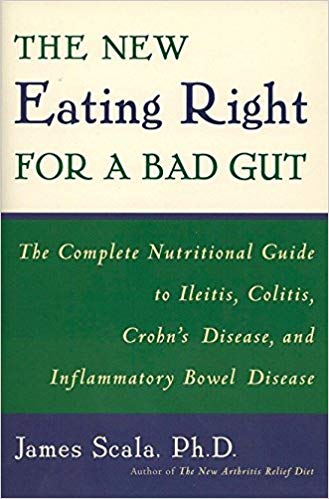
Newly Diagnosed? Start with this book…

Even if you’re an IBD vet., this book is filled with useful info. – the difference between insoluble and soluble fiber and how to put together a diet that minimizes vs. maximizes inflammation. The concept of breaking down the “fiber matrix” is great too (e.g. frozen veg., cooking/peeling veggies.).

httphttps://www.penguinrandomhouse.com/books/327452/the-new-eating-right-for-a-bad-gut-by-james-scala/9780452279766/

Hydrogen Sulfide vs. Butyrate

If you have IBD, this is something you should know about. I try to avoid high sulfur foods (list forthcoming) in favor of low-sulfur ones.

A common theme of this blog (and my health efforts) that I urge you to consider for yourself (in whatever way makes sense for you) is to eat things that support the gut lining and a healthy microbiome, and that reduce inflammation. And avoid foods/ingredients that degrade the microbiome, increase intestinal permeability (and/or damage the intestines), and cause inflammation.

My hope is that this blog will serve as a resource that helps you discern what these foods/ingredients are (backed by science and evidence).

IBD: A low-calorie plant diet relieves inflammation, repairs gut

In a study paper that now features in the journal Cell Reports, they describe how, compared with water-only fasting, periodic 4-day cycles of the fasting-mimicking diet “partially reversed” hallmarks of IBD in the mice.

https://www.medicalnewstoday.com/articles/324634.php

Use of the ‘nutriceutical’, bovine colostrum, for the treatment of distal colitis: results from an initial study

colostral preparation is able to stimulate remission/repair in a true clinical setting expands on previous in vitro and animal model studies and has direct therapeutic relevance.”

https://onlinelibrary.wiley.com/doi/full/10.1046/j.1365-2036.2002.01354.x

Design a site like this with WordPress.com
Get started